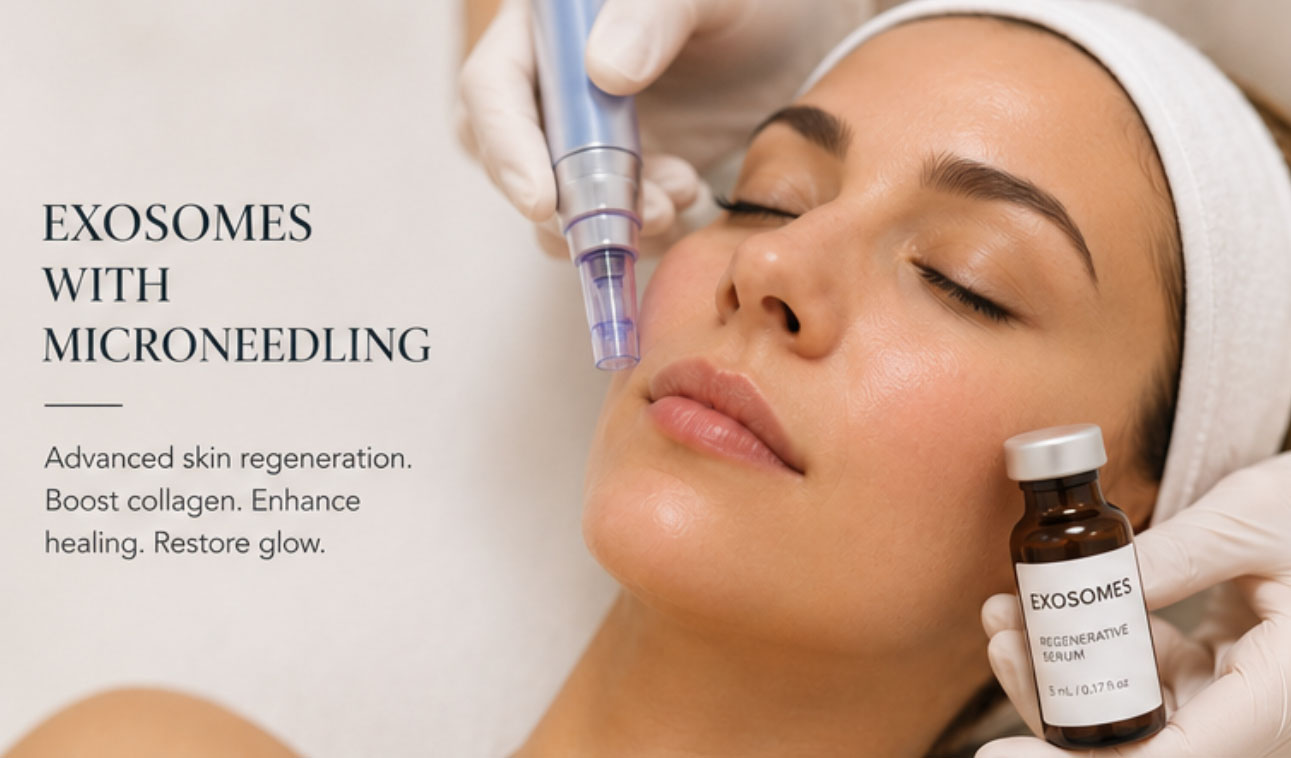
What is microneedling?
Microneedling — also called collagen induction therapy (CIT) — is a procedure in which a device fitted with fine medical-grade needles creates thousands of controlled micro-channels in the skin. These tiny punctures are superficial and heal rapidly, but they trigger the skin's natural wound-healing cascade: an influx of growth factors, fibroblast activation, and a robust surge in collagen and elastin synthesis.
On its own, microneedling is already an effective treatment for acne scars, enlarged pores, fine lines, and uneven skin texture. But its real power is unlocked when combined with active biological agents — and that is where exosomes come in.
What are exosomes — and why do they matter for skin?
Exosomes are nano-sized extracellular vesicles, typically 30 to 150 nanometres in diameter, secreted by stem cells. They are not cells themselves — they are biological messengers, carrying a rich payload of:
- Growth factors — including EGF, VEGF, TGF-β, and FGF, which drive skin repair and collagen production
- MicroRNA — tiny regulatory molecules that reprogram damaged skin cells to behave like younger, healthier cells
- Proteins and lipids — structural components that support the skin's extracellular matrix
- Anti-inflammatory cytokines — which calm post-procedure inflammation and reduce the risk of post-inflammatory hyperpigmentation (PIH)
The key advantage of exosomes over traditional PRP or topical growth serums is their ability to penetrate cell membranes and directly influence gene expression within recipient cells. They essentially instruct your skin cells to regenerate more efficiently and more completely.
Microneedling creates temporary micro-channels in the skin — bypassing the stratum corneum (the skin's outer barrier) and dramatically increasing the absorption of any substance applied immediately after. Exosomes delivered through these micro-channels reach the dermal fibroblasts and keratinocytes directly, where they can exert their regenerative effects at the cellular level. This is not a topical — it is a targeted intracellular delivery system.
What conditions does microneedling with exosomes treat?
At Reva Skin and Hair Clinic, Dr. Acharya uses this combination to treat a wide range of skin concerns:
- Acne scars — atrophic (pitted) scars, rolling scars, and boxcar scars respond particularly well. The combination of collagen induction from microneedling and cellular reprogramming from exosomes produces more complete scar filling than microneedling alone.
- Enlarged pores — pore size visibly reduces as the surrounding collagen matrix tightens over 4 to 8 weeks.
- Uneven skin texture and rough skin — surface irregularities smooth significantly after 2 to 3 sessions.
- Fine lines and early wrinkles — particularly perioral lines, forehead lines, and crow's feet respond well.
- Skin dullness and loss of radiance — exosomes have a brightening effect by regulating melanogenesis (pigment production) and improving microcirculation.
- Post-inflammatory hyperpigmentation (PIH) — the anti-inflammatory properties of exosomes help prevent and treat the dark marks left after acne or other inflammation.
- Melasma (adjunctive) — used carefully as part of a broader melasma management protocol.
- Skin aging and loss of firmness — a powerful alternative or complement to laser resurfacing for patients seeking rejuvenation without significant downtime.
Microneedling with Exosomes vs Microneedling with PRP
| Feature | Microneedling + PRP | Microneedling + Exosomes |
|---|---|---|
| Source | Patient's own blood | Stem cell-derived (external) |
| Potency of growth factors | Moderate | Very high — 100x more growth factors than PRP |
| Anti-inflammatory effect | Mild | Strong — lowers PIH risk |
| Consistency of results | Variable (depends on platelet count) | Standardised and consistent |
| Sessions required | 3–4 | Often 2–3 |
| Downtime | 24–48 hours redness | 12–24 hours — faster recovery |
| Suitable for darker skin tones | Yes, with care | Excellent — very low PIH risk |
| Blood draw required | Yes | No |
What happens during the procedure?
A typical microneedling with exosomes session at Reva Skin and Hair Clinic follows this sequence:
- Consultation and skin assessment — Dr. Acharya evaluates your skin concerns, history, and suitability. Skin is cleansed and assessed for active lesions, infections, or contraindications.
- Topical anaesthesia — a prescription-strength numbing cream is applied and left for 30 to 45 minutes to ensure a comfortable procedure.
- Microneedling — a medical-grade microneedling device is passed over the treatment area in multiple directions. Needle depth is adjusted based on the area being treated and the condition (deeper for scars, superficial for texture and pigmentation).
- Exosome application — immediately after microneedling, the exosome solution is applied to the skin while the channels are open. The exosomes penetrate deeply through the micro-channels into the dermis.
- Post-procedure care — a calming serum and broad-spectrum sunscreen are applied. Instructions for home care are provided in detail.
Total procedure time: approximately 60 to 90 minutes. The procedure itself (after numbing) takes around 20 to 30 minutes.
What results can you expect — and when?
Results develop gradually as new collagen matures:
- Day 1–3: Mild redness and a warm, sunburn-like sensation. Skin may feel tight. This is normal and expected.
- Week 1: Redness fades. Skin may appear slightly "rough" as the surface renews. Some patients notice a subtle initial glow.
- Week 2–4: Skin begins to feel smoother and more even. Pore size visibly reduces.
- Month 2–3: Collagen production peaks. Scars begin to fill, texture improves significantly, and radiance is noticeably enhanced.
- Month 3–6: Full result is visible. Improvement is progressive and natural-looking — not the sudden, overdone result that patients sometimes fear.
Microneedling with exosomes does not erase deep scars in a single session — it rebuilds the skin progressively. Most patients see 40–70% improvement in scar depth after a course of treatment. The results are real, natural, and lasting. For severe or icepick scars, adjunctive treatments (subcision, TCA cross, fractional CO2 laser) may be recommended alongside.
How many sessions are needed?
For most patients, a course of 3 sessions spaced 4 to 6 weeks apart produces optimal results. Some indications (mild texture, general rejuvenation) may respond well in 2 sessions. Deeper scarring or more advanced aging may benefit from 4 to 6 sessions. An annual maintenance session is recommended to sustain collagen levels.
Who is NOT suitable for this treatment?
- Active acne, open wounds, or skin infections in the treatment area
- Keloid scar formers (risk of hypertrophic response)
- Current use of isotretinoin (Accutane) — must wait at least 6 months after stopping
- Active herpes simplex — antiviral prophylaxis needed before treating near the lip area
- Pregnancy
- Certain blood disorders or anticoagulant medications (discuss with Dr. Acharya)
Post-procedure care instructions
Proper aftercare is essential for maximising results and avoiding complications:
- Day 1–3: Use only a gentle cleanser, fragrance-free moisturiser, and SPF 50+. No active ingredients (retinoids, acids, vitamin C) — the skin barrier is temporarily compromised.
- Day 4 onwards: Gradually reintroduce your regular skincare. Avoid direct sun exposure for at least one week.
- Ongoing: Sunscreen is non-negotiable. UV exposure directly after microneedling can trigger PIH, especially in darker skin tones — the very problem we are trying to avoid.
- Avoid: Swimming pools, saunas, intense exercise (sweating) for 48 hours. No makeup for the first 24 hours.
Microneedling with exosomes at Reva Skin and Hair Clinic, Kathmandu
We use the highest quality exosomes directly sourced from Korea to ensure maximum results. The cost of each session is NRs. 12000.
Dr. Prakash Acharya performs microneedling with exosome therapy at both branches of Reva Skin and Hair Clinic — Sorhakhutte and Kamalpokhari, Kathmandu. Every treatment begins with a detailed skin assessment and is customised to your specific concern, skin type, and treatment goals. No two protocols are identical, because no two patients are.
If you would like to know whether microneedling with exosomes is the right treatment for your skin, book a consultation and Dr. Acharya will give you an honest, personalised recommendation.