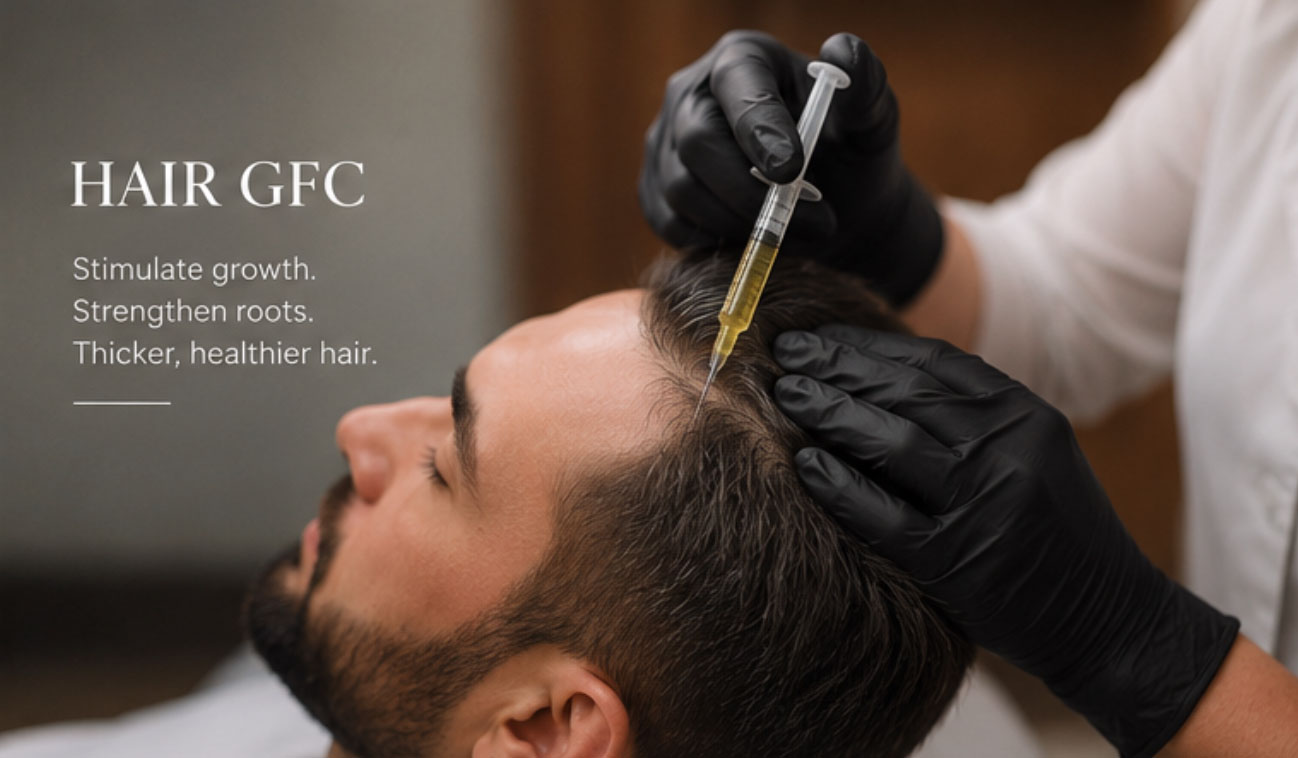
What is GFC — and how is it different from PRP?
GFC stands for Growth Factor Concentrate. Like PRP (Platelet-Rich Plasma), it is derived from the patient's own blood. However, where PRP concentrates platelets (which then release growth factors when activated), GFC goes a step further — it uses a specialised proprietary tube system to selectively extract and concentrate only the growth factors themselves, leaving behind the platelets, red blood cells, and white blood cells that contribute to post-injection inflammation.
The result is a cleaner, purer, more potent preparation with consistently high levels of the specific growth factors responsible for hair follicle stimulation: PDGF (Platelet-Derived Growth Factor), VEGF (Vascular Endothelial Growth Factor), EGF (Epidermal Growth Factor), IGF-1 (Insulin-like Growth Factor-1), and FGF (Fibroblast Growth Factor).
PRP gives you a concentration of platelets — which are the containers of growth factors. GFC extracts the growth factors directly, without the platelet shell. This means more growth factor per millilitre, less inflammatory material, less post-injection discomfort, and more consistent results between sessions and between patients.
How do growth factors stimulate hair regrowth?
The hair follicle is a mini-organ with its own cycle: anagen (active growth), catagen (transition), and telogen (resting/shedding). In hair loss conditions like androgenetic alopecia (male and female pattern hair loss), follicles progressively miniaturise — producing finer, shorter hairs — and the anagen phase shortens. Eventually, the follicle may become dormant.
The growth factors in GFC act on multiple levels:
- PDGF and VEGF stimulate blood vessel formation around the follicle, improving nutrient and oxygen delivery — which is often significantly reduced in areas of thinning.
- EGF and KGF promote keratinocyte proliferation — the cells that form the hair shaft itself.
- IGF-1 extends the anagen (growth) phase, meaning hairs stay in the active growth cycle longer before shedding.
- FGF activates dormant dermal papilla cells — the master controllers of the hair follicle that can, when stimulated, reactivate miniaturised follicles.
Collectively, these actions result in: reduced shedding, thicker individual hair shafts, increased hair density, and in early hair loss, reactivation of dormant follicles.
Who is GFC best suited for?
GFC is most effective for:
- Androgenetic alopecia (male and female pattern hair loss) — Grades I to III on the Norwood/Hamilton scale for men; Ludwig I to II for women. The earlier, the better.
- Telogen effluvium — diffuse shedding triggered by nutritional deficiency, thyroid imbalance, crash diets, post-partum hair loss, or stress. GFC accelerates recovery and reduces the shedding phase.
- Alopecia areata — as an adjunct to standard treatment (minoxidil, corticosteroid injections) to improve follicle health in patchy hair loss.
- Hair thinning in women with PCOS — where hormonal alopecia coexists with scalp inflammation.
- Post hair transplant patients — GFC is increasingly used after FUE/FUT transplant to improve graft survival and accelerate regrowth.
GFC is less effective for completely bald areas where follicles are irreversibly lost — in those cases, hair transplant surgery is the appropriate intervention.
What does a GFC session involve?
- Trichoscopy assessment — Dr. Acharya uses a dermatoscope to examine the scalp, assess follicle density, miniaturisation patterns, and scalp health before commencing treatment.
- Blood draw — approximately 16–20 ml of blood is drawn from a vein in the arm — less than a standard blood test tube.
- GFC preparation — the blood is processed using the specialised GFC kit, which concentrates the growth factors through an optimised centrifugation protocol.
- Scalp preparation and anaesthesia — the scalp is cleansed with antiseptic. Topical anaesthetic cream and/or a nerve block may be used depending on patient preference.
- Injection — GFC is injected into the scalp in a grid pattern across the thinning areas using a fine needle. Approximately 50–80 microinjections are made per session.
- Post-procedure care — the scalp is cleaned. Instructions are given for the next 24 to 48 hours.
Total duration: approximately 45 to 60 minutes per session.
Results timeline: what to expect, week by week
Many patients notice a decrease in the amount of hair falling during washing and combing. This is often the first, and most reassuring, sign that the treatment is working.
The scalp may feel healthier — less dry, less itchy. Some patients begin to see fine new hairs in previously thinning areas. These are called "vellus hairs" and represent reactivated follicles.
By this point, new hairs have grown enough to create visible improvements in density. Hair appears thicker and fuller, particularly at the crown and along the hairline.
The full benefit of a course of GFC is typically visible at 6 months. Density is at its highest, hair shaft thickness is improved, and the overall volume of hair is significantly greater than before treatment began.
Results gradually diminish over 6 to 12 months without maintenance sessions. A single maintenance GFC session every 6 months is recommended to sustain results long-term.
GFC vs PRP: Which should you choose?
| Feature | PRP | GFC |
|---|---|---|
| What is concentrated | Platelets | Growth factors directly |
| Growth factor purity | Moderate | High — standardised concentration |
| Post-injection pain | Moderate (due to platelet activation) | Mild — less inflammatory response |
| Consistency between sessions | Variable | Consistent |
| Sessions for initial course | 3–4 | 3 (sometimes 2 sufficient) |
| Result onset | 2–3 months | Often noticeable from 4–6 weeks |
| Suitable for women with low platelet count | Reduced efficacy | Not affected — growth factors extracted regardless |
At Reva Skin and Hair Clinic, Dr. Acharya recommends GFC as the first choice for most hair loss patients due to its superior comfort, consistency, and slightly faster onset of results. PRP remains an excellent option, particularly when cost is a consideration.
Can GFC be combined with other hair loss treatments?
Yes — and combining treatments almost always produces better outcomes than any single modality alone:
- GFC + Minoxidil (topical or oral): The most common and effective combination. Minoxidil extends the anagen phase and improves scalp blood flow; GFC provides direct follicular stimulation. Together, they address hair loss from complementary mechanisms.
- GFC + Finasteride/Dutasteride (for men): DHT-blocking medications address the hormonal root cause of androgenetic alopecia. GFC amplifies the follicular response while the medication stabilises further loss.
- GFC + Exosomes: For patients who want maximum regenerative effect, Dr. Acharya can alternate GFC with exosome scalp injections — leveraging the different but complementary mechanisms of both.
- GFC + Low-Level Laser Therapy (LLLT): Home-use laser caps or in-clinic laser sessions can complement GFC by further stimulating follicle metabolism.
Is GFC safe? Are there side effects?
GFC is derived from your own blood — making it completely biocompatible and carrying zero risk of allergic reaction. It is one of the safest procedures in dermatology. Side effects are typically mild and short-lived:
- Mild scalp tenderness at injection sites: resolves in 24–48 hours
- Occasional small bumps or swelling at injection points: resolves in 24–72 hours
- Rare: temporary "shock loss" (increased shedding in the first 2–4 weeks) — this is a normal and transient response, indicating follicle cycle resetting, and is followed by regrowth
GFC does not create new follicles. It rehabilitates existing ones. This is why starting treatment early — before follicles are irreversibly miniaturised — is so important. The best time to start hair loss treatment is at the first signs of thinning, not after significant loss has already occurred.
How to book GFC treatment in Kathmandu
Dr. Prakash Acharya offers GFC hair treatment at both branches of Reva Skin and Hair Clinic — Sorhakhutte and Kamalpokhari, Kathmandu. Every patient begins with a thorough trichoscopy-based assessment to confirm diagnosis, identify the pattern and severity of loss, and rule out reversible causes (thyroid disease, nutritional deficiency, PCOS) before designing a treatment plan.